
Detecting, Attributing and Communicating climate impacts on health

Attribution and communication of the health impacts of climate change is challenging. Researchers within the HeatNexus Network explored methods to detect and attribute the health impacts of increases in the frequency and intensity of heatwaves because of climate change as part of their Wellcome-funded research.
Professor Kristie L Ebi, Professor at the Center for Health and Global Environment, University of Washington is globally renowned for her work on detection and attribution (D&A) methods in climate and health research. Kristie is also the co-investigator of the CHHANW: Economic and Health Impact Assessment of Heat Adaptation Action project in India.
On 11th September, The Institute of Development Studies (IDS, UK) hosted a webinar where Prof. Ebi shared her experiences by describing how these methods enable researchers to quantify—not just associate—health impacts directly to climate change.
This piece provides a short summary of her presentation and the discussions that ensued.
The Evolution and challenge of Detection and Attribution (D&A)
D&A has progressed dramatically since the 1980s. The first IPCC assessment report in 1990 concluded that detecting the enhanced greenhouse effect was unlikely for a decade or more. By 2022, the IPCC concluded that it is unequivocal that human activities have warmed the atmosphere, ocean, and land. This shift resulted from the rapid pace of climate change itself and significant methodological advances in detection and attribution.
Detection identifies whether a trend has deviated from a baseline, while attribution determines the causal factors behind that change, including climate change. These methods include some long-established approaches in health research (such as quantifying the contribution of individual risk factors to the burden of cardiovascular disease). A key challenge is the lack of standardized baselines in health, unlike in climate science.
From Association to Causation: Real-World Impact
D&A studies transform how we communicate about climate and health. Rather than stating there’s an “association” between temperature and mortality, researchers can now count deaths caused by climate change.
The Pacific Northwest heatwave (heat dome) in 2021 provided a powerful example. This unprecedented event in the Pacific Northwest broke temperature records by 5°C—extraordinary when records are typically broken by tenths of degrees. The World Weather Attribution group determined the event was virtually impossible without climate change. Subsequently, analysis of death certificates revealed the event caused more than 440 excess deaths in Washington State alone. This enabled researchers to state definitively: more than 440 people died because of climate change.
Expanding Applications
Application of detection and attribution methods have expanded beyond extreme heat events:
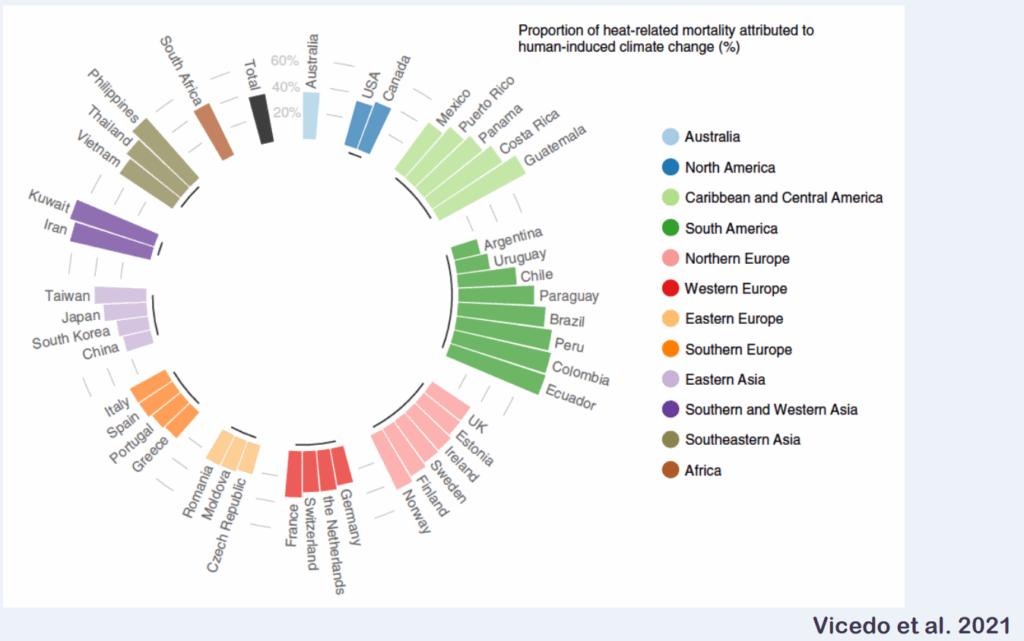
Global heat mortality: A multi-model study across 43 countries and over 700 locations concluded that approximately 37% of heat-related mortality over recent decades was attributable to climate change, with significant regional variation.
Vector-borne diseases: Temperature and precipitation affect mosquito, tick, and sand fly development, survival, and reproduction, as well as pathogen transmission. D&A studies linked climate change to the spread of Lyme disease in Canada (which previously didn’t exist there) and to 35-40% of dengue cases in several Latin American countries. Populations in the Americas experienced over 12 million suspected dengue cases in 2024—a 400% increase, indicating large numbers of people affected by climate change.
Advancing the Field
Recent developments include transdisciplinary frameworks for conducting health D&A studies and increasingly sophisticated analyses. Such analyses are being used to support climate litigation, including a successful lawsuit by Swiss women arguing their government failed to protect them from climate change related impacts.
Communicating with Decision Makers
The value of D&A studies is they can be used to frame important communication and messaging to decision makers. Heat Nexus members, inspired and challenged by the presentation, highlighted several ways D&A can inform policy:
- Provide credible evidence to support rigorous, evidence-informed policymaking
- Enable accountability by documenting evidence (lives lost, hospitalizations) and costs to health systems)
- Emphasize the present crisis: climate change is not a future problem but a today problem requiring immediate action
Challenges remain, particularly the lack of adequate health data in many regions (notably Africa, where only one country was represented in global analyses) and the complexity of communicating counterfactual analyses to policymakers who may prefer information about interventions over attribution studies.
Looking forward
D&A studies represent a critical evolution in climate and health research, moving beyond describing associations to quantifying causation. As the field rapidly develops—with only dozens of studies completed to date—there’s an urgent need and tremendous opportunity for expanded research, particularly in underrepresented regions. By providing concrete numbers of climate-attributable deaths and illnesses, D&A studies offer powerful evidence to drive policy action, resource allocation, and legal accountability in addressing the health impacts of climate change. Achieving the potential of D&A analyses requires research investments, capacity building, and data collection in low resource settings.
For more on D&A studies see article The attribution of human health outcomes to climate change: transdisciplinary practical guidance